

Your daily news update on Europe
Provided by AGP
Industrial Router Market to Reach US$18.6 Billion by 2033 from US$9.9 Billion in 2026 at 9.3% CAGR Outlook
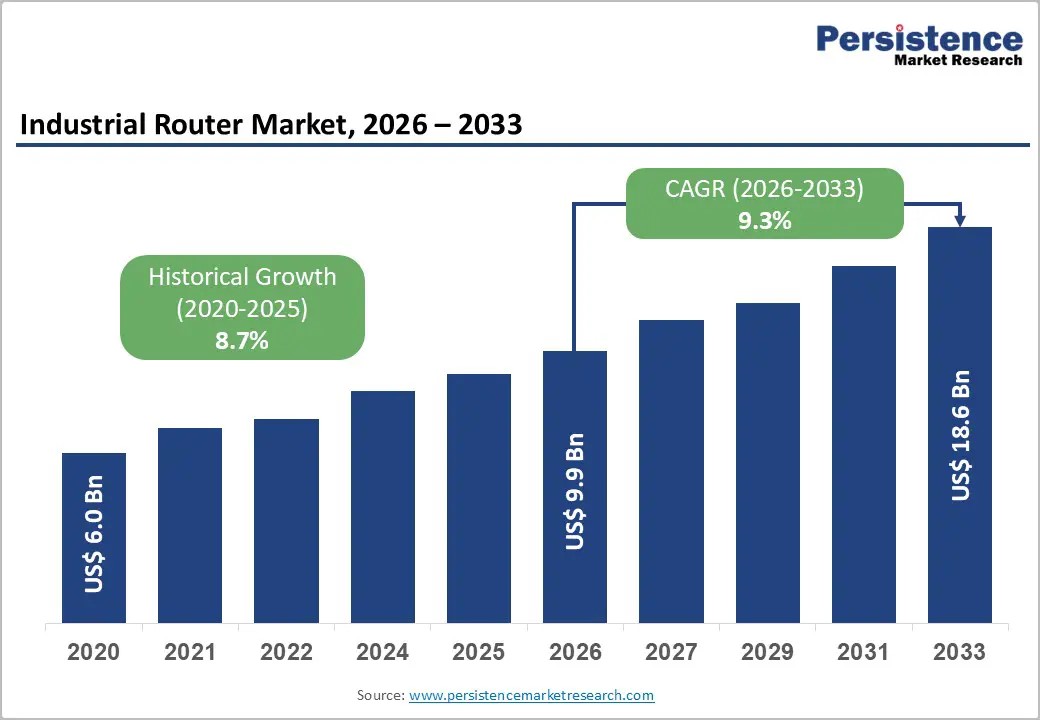
The global industrial router market to grow from US$ 9.9 Bn in 2026 to US$ 18.6 Bn by 2033, registering a 9.3% CAGR during the 2026–2033 forecast period
BRENTFORD, ENGLAND, UNITED KINGDOM, May 13, 2026 /EINPresswire.com/ -- The global industrial router market is undergoing a significant transformation as industries increasingly adopt connected, automated, and data-driven operations. Valued at US$9.9 billion in 2026, the market is projected to reach US$18.6 billion by 2033, expanding at a CAGR of 9.3% during the forecast period. This growth is strongly influenced by the rapid adoption of Industry 4.0 technologies, including Industrial Internet of Things (IIoT), edge computing, artificial intelligence, and private 5G networks. Industrial routers are no longer just connectivity devices; they have evolved into intelligent gateways that support secure data transmission, real-time analytics, and machine-to-machine communication across critical industrial environments.
A key growth driver of the industrial router market is the convergence of Operational Technology (OT) with Information Technology (IT), which is reshaping industrial network architectures worldwide. The increasing deployment of smart factories, automated logistics systems, and remote monitoring solutions is significantly boosting demand for reliable and rugged connectivity infrastructure. Among segments, wired industrial routers dominate with nearly 55% market share, driven by their reliability and deterministic performance in mission-critical environments. Meanwhile, North America leads the global market with around 34% share, primarily due to early adoption of advanced automation technologies, strong presence of major vendors, and high investment in industrial digitalization across utilities, manufacturing, and defense sectors.
𝐆𝐞𝐭 𝐚 𝐒𝐚𝐦𝐩𝐥𝐞 𝐏𝐃𝐅 𝐁𝐫𝐨𝐜𝐡𝐮𝐫𝐞 𝐨𝐟 𝐭𝐡𝐞 𝐑𝐞𝐩𝐨𝐫𝐭: https://www.persistencemarketresearch.com/samples/32506
Market Segmentation of Industrial Router Market
The industrial router market is segmented by product type, enterprise size, and end-use industries. Based on product type, it includes wired and wireless industrial routers, where wired routers dominate due to their reliability, low latency, and suitability for harsh industrial environments, while wireless routers are growing rapidly with the rise of 5G and flexible industrial connectivity needs.
By enterprise size, large enterprises lead the market owing to strong automation investments and complex multi-site operations, whereas SMEs are emerging as a high-growth segment driven by affordable 5G solutions and cloud-based networking. Based on end-use, the market spans manufacturing, energy and utilities, transportation, oil and gas, and mining, each requiring highly specialized and resilient connectivity solutions.
Regional Insights of the Industrial Router Market
North America remains the dominant region in the industrial router market, supported by strong technological infrastructure, early adoption of Industry 4.0 practices, and widespread implementation of smart manufacturing systems. The United States plays a central role in driving regional growth, particularly due to reshoring initiatives, semiconductor expansion, and rising investments in automation-driven production facilities. The region’s emphasis on cybersecurity compliance and critical infrastructure protection further strengthens demand for high-performance, secure industrial routers.
Europe represents a highly regulated and technologically mature market, where industrial router adoption is strongly influenced by stringent data security regulations and advanced manufacturing standards. Countries like Germany, the United Kingdom, and France are at the forefront, driven by strong industrial automation ecosystems and Industry 4.0 initiatives. Meanwhile, Asia Pacific is emerging as the fastest-growing region, fueled by large-scale manufacturing expansion, rapid urbanization, and government-led digital transformation programs. China, India, Japan, and Southeast Asia are key contributors, benefiting from rising industrial investments and the relocation of global supply chains toward the region.
Market Drivers
The industrial router market is primarily driven by the rapid expansion of Industrial IoT ecosystems and the growing need for seamless IT-OT integration. As industries increasingly rely on connected devices, sensors, and automated systems, the demand for robust, secure, and low-latency networking solutions continues to rise. The rollout of private 5G networks and edge computing architectures further accelerates this demand, enabling real-time communication and decentralized data processing across industrial environments. Additionally, the shift toward smart factories and predictive maintenance systems is encouraging enterprises to invest in next-generation industrial routers that support AI-driven operations and high-bandwidth connectivity.
𝐃𝐨 𝐘𝐨𝐮 𝐇𝐚𝐯𝐞 𝐀𝐧𝐲 𝐐𝐮𝐞𝐫𝐲 𝐎𝐫 𝐒𝐩𝐞𝐜𝐢𝐟𝐢𝐜 𝐑𝐞𝐪𝐮𝐢𝐫𝐞𝐦𝐞𝐧𝐭? 𝐑𝐞𝐪𝐮𝐞𝐬𝐭 𝐂𝐮𝐬𝐭𝐨𝐦𝐢𝐳𝐚𝐭𝐢𝐨𝐧 𝐨𝐟 𝐑𝐞𝐩𝐨𝐫𝐭: https://www.persistencemarketresearch.com/request-customization/32506
Market Restraints
Despite strong growth prospects, the industrial router market faces several challenges that may hinder its expansion. One of the major restraints is the high complexity involved in integrating industrial routers with legacy systems and existing industrial networks. Many organizations still operate on outdated infrastructure, making seamless migration to advanced networking systems difficult and costly. Additionally, limitations in industrial redundancy protocols and the lack of standardized implementations across devices create compatibility issues in mission-critical environments. High initial deployment costs, coupled with cybersecurity risks in connected industrial systems, further restrict adoption, especially among small and medium enterprises.
Market Opportunities
The increasing adoption of edge computing presents a significant opportunity for the industrial router market. By enabling local data processing at the network edge, industrial routers can reduce latency, improve decision-making speed, and enhance operational efficiency. This is particularly beneficial for industries such as oil and gas, mining, and remote manufacturing facilities where cloud dependency is limited due to connectivity constraints. Furthermore, the growing deployment of autonomous robots, smart logistics systems, and AI-enabled industrial applications is expected to create new demand for advanced routers with built-in computing capabilities. Vendors that integrate containerized applications and edge intelligence into router platforms are likely to gain a strong competitive advantage in the coming years.
𝐁𝐮𝐲 𝐍𝐨𝐰 𝐭𝐡𝐞 𝐃𝐞𝐭𝐚𝐢𝐥𝐞𝐝 𝐑𝐞𝐩𝐨𝐫𝐭: https://www.persistencemarketresearch.com/checkout/32506
Company Insights
• Cisco Systems
• Siemens
• Huawei Technologies
• HMS Networks
• Digi International
• Advantech
• Moxa
• Teltonika Networks
• Sierra Wireless
• Juniper Networks
• Belden
• Ericsson
• Nokia
• Westermo
• Phoenix Contact
Conclusion
The industrial router market is poised for strong and sustained growth as industries continue to transition toward fully connected, intelligent, and automated ecosystems. The integration of private 5G networks, edge computing, and Industrial IoT is fundamentally reshaping industrial communication infrastructure, elevating routers into strategic components of digital transformation. While challenges such as legacy system integration and cybersecurity concerns persist, the long-term outlook remains highly positive. With strong demand across manufacturing, energy, transportation, and logistics sectors, industrial routers will remain essential enablers of real-time connectivity and operational intelligence through 2033.
Related Reports:
Pooja Gawai
Persistence Market Research
+1 646-878-6329
email us here
Visit us on social media:
LinkedIn
Instagram
Facebook
YouTube
X
Legal Disclaimer:
EIN Presswire provides this news content "as is" without warranty of any kind. We do not accept any responsibility or liability for the accuracy, content, images, videos, licenses, completeness, legality, or reliability of the information contained in this article. If you have any complaints or copyright issues related to this article, kindly contact the author above.
