

Your daily news update on Europe
Provided by AGP
Liqueurs and Specialty Spirits Market Size and Trends Analysis 2033
liqueurs and specialty spirits market
The liqueurs and specialty spirits market is growing, driven by premiumization, mixology trends, flavor innovation, and evolving consumer preferences.
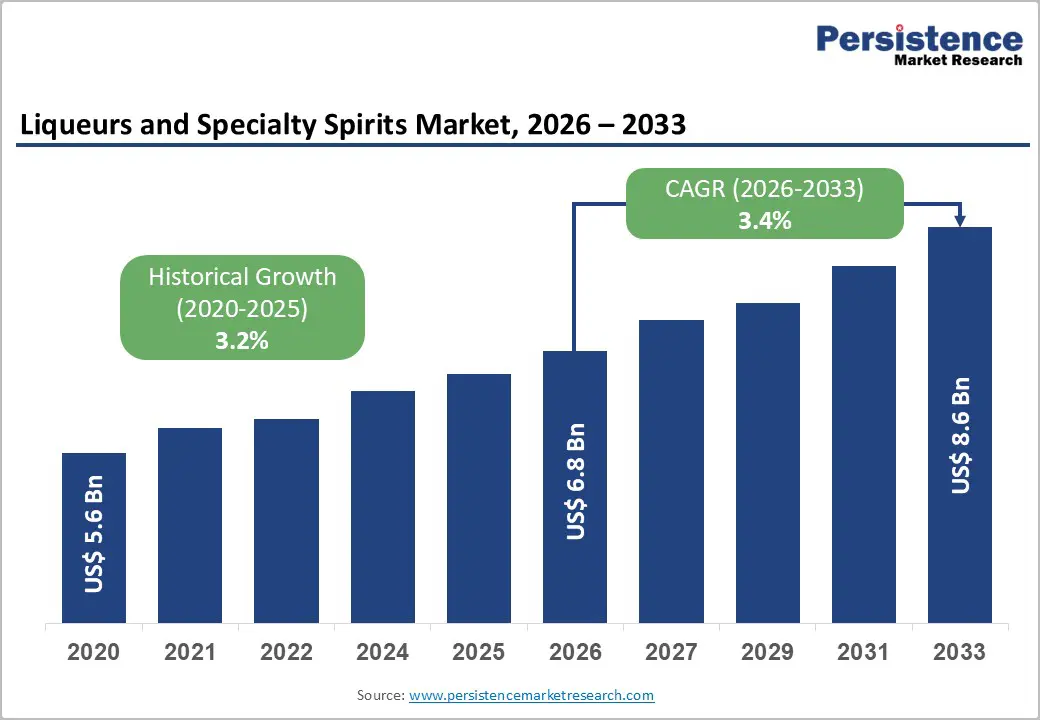
LONDON, UNITED KINGDOM, May 21, 2026 /EINPresswire.com/ -- The global liqueurs and specialty spirits market is projected to reach a valuation of US$6.8 billion by 2026 and is expected to grow to US$8.6 billion by 2033, reflecting a compound annual growth rate (CAGR) of 3.4% during the forecast period. This growth is largely fueled by evolving consumer preferences, where demand for flavored, versatile, and experience-oriented alcoholic beverages is steadily rising. Increasing interest in cocktail culture and at-home mixology has positioned liqueurs as essential ingredients, while specialty spirits gain traction for their artisanal appeal and unique flavor profiles.
Consumers are increasingly gravitating toward premium and craft offerings, emphasizing authenticity, high-quality ingredients, and distinctive taste experiences. Liqueurs continue to fulfill dual roles as both cocktail enhancers and indulgent standalone beverages, appealing to a broad demographic. Health-conscious trends are also shaping market dynamics, as demand grows for low-alcohol, low-sugar, and naturally infused variants that align with moderation and wellness-oriented consumption.
Download Your Free Sample & Explore Key Insights: https://www.persistencemarketresearch.com/samples/21487
Key Industry Highlights
North America is anticipated to lead the market, accounting for approximately 40% of global revenue in 2026. The region’s dominance is attributed to strong U.S. leadership, premiumization trends, and a well-established innovation ecosystem. Meanwhile, Asia Pacific is projected to be the fastest-growing market due to rapid urbanization, rising disposable incomes, and increasing adoption of Western drinking trends. In terms of product type, herbal liqueurs are expected to hold the largest revenue share of 35% in 2026, driven by their versatility and growing consumer preference for botanical flavors. Standard alcohol content (15% to 30%) is likely to dominate, representing over 45% of market revenue, supported by its balanced strength and widespread application in cocktails.
Market Drivers
The rising popularity of cocktail culture and at-home mixology is a key driver. Digital platforms, bartender tutorials, and social media trends have increased awareness of premium ingredients, encouraging consumers to experiment with unique flavor combinations. At-home mixology has surged, aided by ready-to-use cocktail kits, online ingredient delivery services, and small-batch premium products, which simplify recreating bar-quality beverages and promote seasonal flavor experimentation.
Premiumization and flavor innovation also drive growth. Consumers increasingly favor high-end products with artisanal craftsmanship, distinctive flavors, and authentic brand stories. Manufacturers respond by focusing on small-batch production, sourcing unique ingredients, and refining distillation techniques. Flavor innovation, including botanical, exotic, and fusion-based offerings, further enhances consumer engagement. Limited-edition releases and collaborations reinforce exclusivity while diversifying product portfolios.
Market Restraints
Health and moderation trends pose challenges, as consumers become more mindful of alcohol intake, calorie content, and sugar levels. This shift has prompted manufacturers to develop low-alcohol, low-sugar, and clean-label variants, combining indulgence with health-conscious attributes to maintain engagement while navigating regulatory and social expectations.
Supply chain constraints and ingredient sourcing also affect the market. Liqueurs and specialty spirits rely on diverse raw materials, such as fruits, herbs, spices, and dairy components, making production vulnerable to climate variability, seasonal fluctuations, and geopolitical disruptions. Premium products dependent on specific origins require resilient supply chains and strategic sourcing partnerships to ensure quality and consistency.
Get Custom Insights Designed for Your Businecss: https://www.persistencemarketresearch.com/request-customization/21487
Opportunities
Technological advancements enable innovation in low and no-alcohol liqueurs, allowing brands to retain complex flavors while reducing alcohol content. Functional and plant-based ingredients, botanical infusions, and natural sweeteners expand appeal to health-conscious consumers. Ready-to-drink (RTD) beverages further drive convenience-focused consumption, offering consistent flavor profiles and accessibility for younger and urban demographics. Collaboration with mixologists and packaging innovations reinforce product appeal and modern relevance.
Category Insights
Herbal liqueurs are projected to lead with a 35% revenue share in 2026 due to their versatility in cocktails and premium positioning. Fruit liqueurs represent the fastest-growing segment, attracting younger consumers with lighter, sweeter flavors suitable for seasonal cocktails and experimental mixology. Standard alcohol content liqueurs dominate with around 45% of revenue, while low-alcohol variants show the fastest growth driven by wellness-conscious consumption patterns.
Regional Insights
North America maintains leadership, fueled by premiumization, a strong cocktail culture, and e-commerce channels enhancing accessibility. Europe remains significant due to its heritage in liqueur production, premium and artisanal preferences, and resurgence in aperitif culture. Asia Pacific is the fastest-growing market, supported by urbanization, rising incomes, Western lifestyle adoption, and a young population open to experimentation. Local and international players invest in product localization, e-commerce, and distribution expansion to capture growth.
Competitive Landscape
The market is moderately fragmented, featuring both multinational corporations and craft distillers. Key players include Pernod Ricard, Bacardi Limited, Brown-Forman, Davide Campari-Milano, Rémy Cointreau, and Suntory Holdings. Competition is driven by product innovation, premiumization, strategic acquisitions, and expansion into emerging markets. Companies are actively introducing low-alcohol, flavored, and ready-to-drink variants to strengthen brand positioning and consumer engagement.
Market Segmentation
By Product Type
Herbal Liqueurs
Cream Liqueurs
Citrus Liqueurs
Fruit Liqueurs
Nut Liqueurs
By Base Ingredient
Grain-based
Fruit-based
Herb and Spice-based
Nut-based
Vegetable-based
By Alcohol Content
Low Alcohol (up to 15%)
Standard Alcohol (15% to 30%)
High Alcohol (above 30%)
By Region
North America
Europe
East Asia
South Asia & Oceania
Latin America
Middle East & Africa
Checkout Now & Download Complete Market Report: https://www.persistencemarketresearch.com/checkout/21487
Key Developments
In 2026, Brown-Forman expanded its premium portfolio in India, while Puranique Spirits entered the market with premium vodka and cognac. Zamora Company partnered with Monika Alcobev to launch Licor 43, and Radico Khaitan strengthened its premium whisky offerings, reflecting the region’s growing demand for high-end spirits.
The liqueurs and specialty spirits market is evolving rapidly, shaped by premiumization, mixology trends, health-conscious consumption, and regional growth dynamics, presenting opportunities for innovation, diversification, and sustained global expansion.
Read Related Reports:
Food Spread Market: The global food spread market is set to grow from US$39.2 Bn in 2026 to US$48.2 Bn by 2033, registering a CAGR of 3%.
Cranberry Extract Market: The global cranberry extract market is projected to reach US$2.1B by 2032, growing at 6% CAGR, driven by health, immunity, and natural supplement demand.
Persistence Market Research
Persistence Market Research Pvt Ltd
+1 646-878-6329
email us here
Visit us on social media:
LinkedIn
Instagram
Facebook
YouTube
X
Legal Disclaimer:
EIN Presswire provides this news content "as is" without warranty of any kind. We do not accept any responsibility or liability for the accuracy, content, images, videos, licenses, completeness, legality, or reliability of the information contained in this article. If you have any complaints or copyright issues related to this article, kindly contact the author above.
